
Ketamine Infusion Therapy in Portland, Maine
IV ketamine for severe, treatment-resistant depression — delivered in a private room with continuous clinical monitoring. Not covered by insurance, and we're upfront about that from the first call.
Ketamine infusion therapy delivers carefully dosed IV ketamine in a private, monitored room at our South Portland office. A standard induction course is six infusions over three weeks, each lasting 40–60 minutes. Ketamine infusion is not covered by insurance — it is a self-pay treatment, and we confirm full cost with you before you commit.
Is Ketamine Infusion Right for You?
Infusion tends to be a strong fit if…
Infusion is not the right tool if…
Candidacy is confirmed at a psychiatric evaluation before any infusion is scheduled — including an honest conversation about whether a covered option should be tried first.
The Infusion Protocol
Infusions run Tuesdays and Thursdays, 8AM–3PM. The structure is deliberate: enough sessions to know whether it's working, a firm checkpoint so you never pay for treatment that isn't.
What the hour feels like
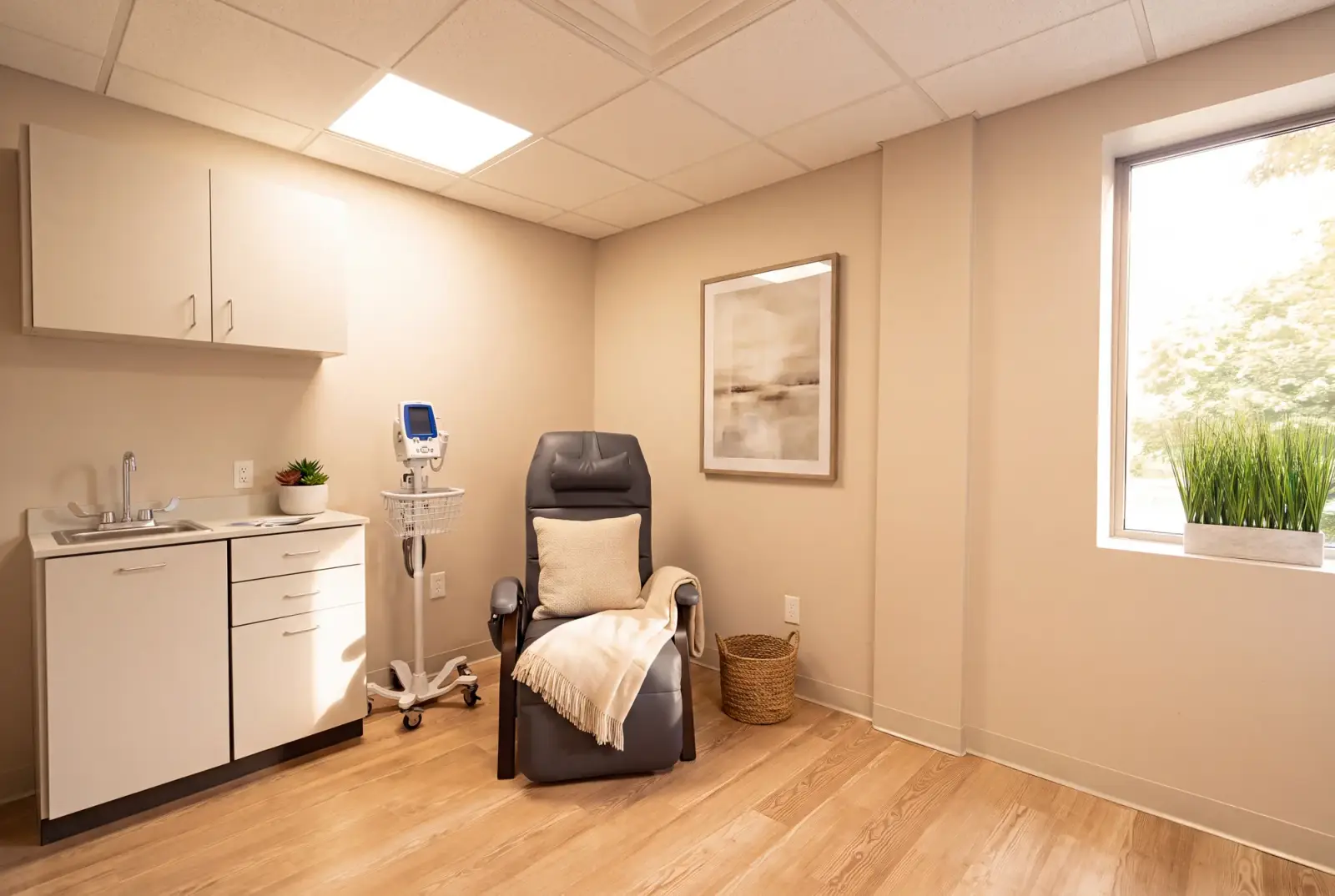
You'll settle into a recliner in a private room — dim lights, a blanket, music if you like. A family member or friend is welcome to sit with you through the whole infusion.
During the drip, most people feel floaty or dream-like; some describe mild dissociation. A clinician monitors your vitals continuously, and the sensation fades within about an hour of finishing.
You'll rest until cleared, then your ride takes you home — no driving until the next day.
Safety & Side Effects
Ketamine has five decades of anesthesia safety history; at antidepressant doses — a fraction of anesthetic ones — serious events are uncommon in screened patients.1
Off-label use for depression is legal, evidence-supported, and disclosed plainly at your evaluation — as is misuse potential, which we screen for.2
Why Insurance Doesn't Cover This
IV ketamine is FDA-approved as an anesthetic, not as a depression treatment — so insurers, including MaineCare, don't reimburse it for mental health use. That's an industry-wide reality, not a Bishop Health policy.
We quote the per-infusion and full-course cost in your first phone call, before any evaluation — no surprise billing, no pressure to prepay for sessions you may not need past the three-session checkpoint.
If cost rules infusion out, Spravato delivers related benefits and is typically covered — we'll tell you honestly which we'd recommend for your situation.
Consider Spravato instead →Infusion, Spravato, or TMS?
Cost, coverage, speed, and time commitment differ sharply — see the honest side-by-side.
Your Infusion Team
“The kindness of everyone there consistently reminds you it's a safe space. It helped me through one of the hardest seasons of my life. I highly recommend this resource to anyone who needs it. They genuinely care.”
“Bishop saved my life. The social workers/clinicians/staff showed they all care and love for each individual. I am so lucky and grateful.”
Ketamine Infusion Questions, Answered
How much does it cost?
We quote exact per-infusion and full-course pricing on your first call — before any appointment, so you can decide with real numbers. Because there's a response checkpoint after session three, you never commit to the full six up front.
Why isn't ketamine infusion covered when Spravato is?
Spravato (esketamine) went through FDA approval specifically for treatment-resistant depression, so insurers cover it. IV ketamine is approved as an anesthetic and used off-label for depression — legal and evidence-supported, but outside what insurance reimburses.
How fast could I feel a difference?
Ketamine is the fastest-acting option we offer — responders often notice a shift within hours to days of an infusion, sometimes after the first or second session. That speed is why it's considered for severe depression when time matters.
What happens if I don't respond?
If there's no measurable improvement after your third infusion, your practitioner may recommend discontinuing rather than completing the course. You'd then pivot — Spravato, TMS, medication changes — without leaving the practice or starting over.
Can someone come with me?
Yes — a family member or friend is welcome in your private room for the entire infusion. Many patients find a familiar presence makes the dissociative period easier; either way, you'll need them (or another ride) to drive you home.
When are infusions scheduled?
Tuesdays and Thursdays, between 8AM and 3PM. Each visit runs 40–60 minutes of infusion plus recovery time — plan on about two hours door to door.
Is this the same thing as 'ketamine clinics' I've seen advertised?
The medication is the same; the context differs. Here, infusions happen inside a psychiatry practice — your evaluation, dosing, monitoring, and everything after (therapy, medication, step-up care) are run by the same clinical team, not a standalone infusion storefront.
Will I be unconscious?
No. Antidepressant dosing is far below anesthesia — you stay awake and able to speak. Most people feel floaty or detached during the drip; it fades within about an hour after the infusion ends.
References
- Sanacora G, et al. A consensus statement on the use of ketamine in the treatment of mood disorders. JAMA Psychiatry. 2017;74(4):399–405.
- Murrough JW, et al. Antidepressant efficacy of ketamine in treatment-resistant major depression: a two-site randomized controlled trial. American Journal of Psychiatry. 2013;170(10):1134–1142.
- Wilkinson ST, et al. The effect of a single dose of intravenous ketamine on suicidal ideation: a systematic review and individual participant data meta-analysis. American Journal of Psychiatry. 2018;175(2):150–158.
Talk through whether infusion makes sense — one call covers candidacy, the full cost, the Tuesday/Thursday schedule, and whether a covered option should come first: (888) 280-2585.