
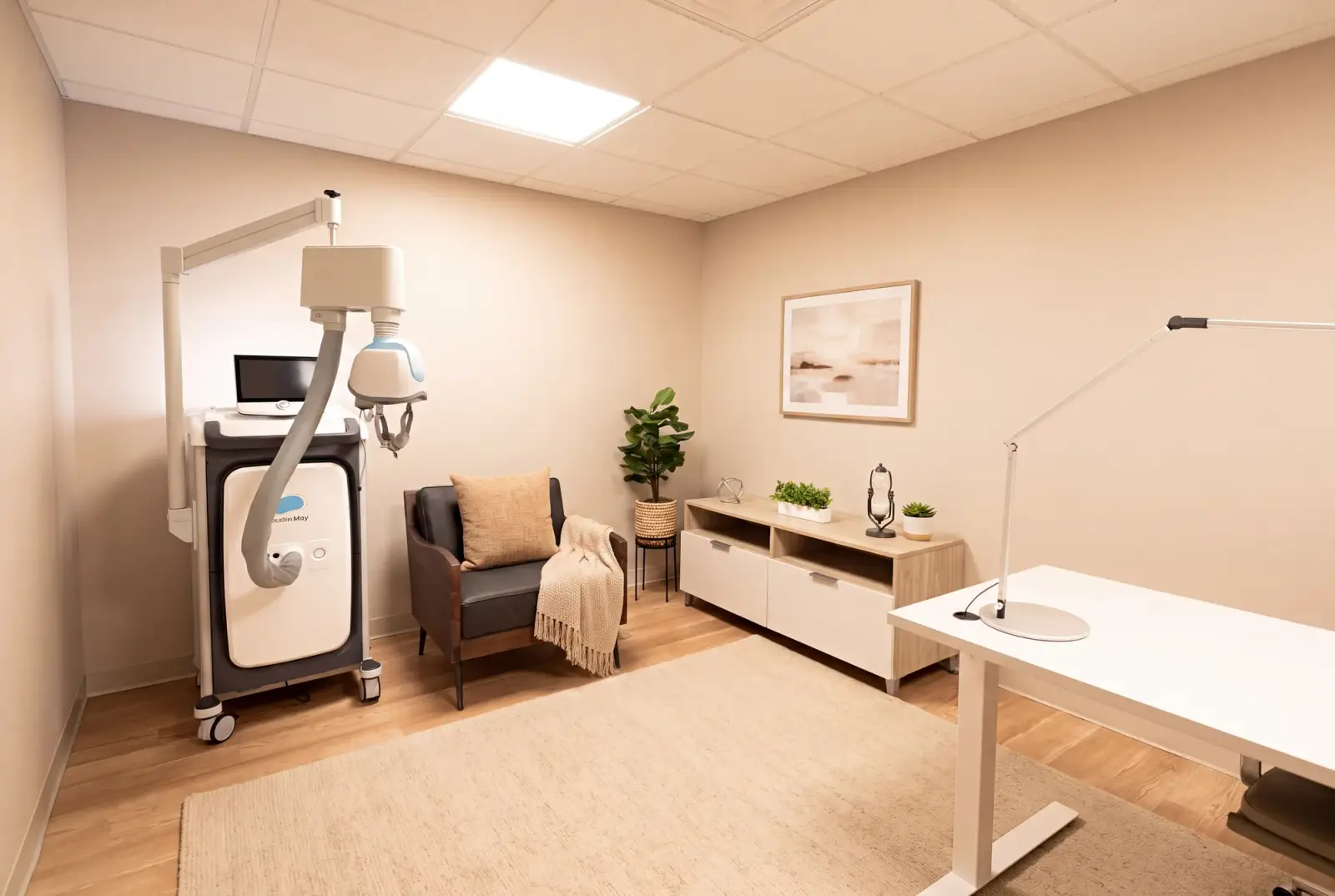
TMS Therapy in Portland, Maine
Drug-free, non-invasive treatment for depression that hasn't responded to medication — awake the whole time, driving yourself home after every session.
Transcranial magnetic stimulation (TMS) is an FDA-approved, non-invasive depression treatment that uses magnetic pulses to stimulate underactive mood circuits in the brain. At Bishop Health in South Portland, sessions take about 20 minutes, require no sedation, and most insurance plans — including MaineCare — cover TMS after prior medication trials.
Is TMS Right for You?
TMS tends to be a strong fit if…
TMS is not the right tool if…
Every TMS course starts with a psychiatric evaluation that screens for all of this — you don't need to self-diagnose before calling.
How TMS Works
Mapping & fitting
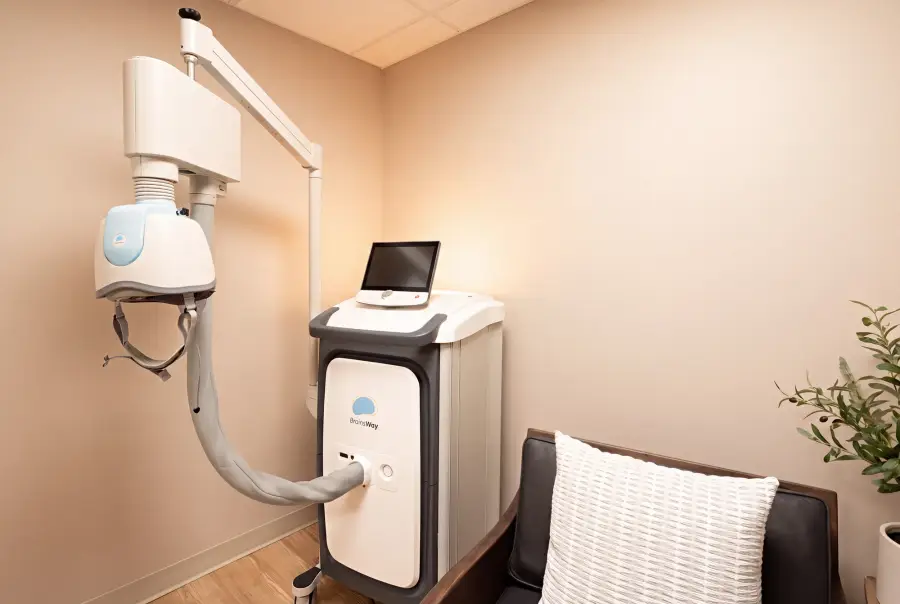
Your first visit locates the exact treatment spot and your personal stimulation dose. A fitted helmet holds the magnetic coil in place.
Targeted pulses
The coil delivers focused magnetic pulses to the prefrontal cortex — the mood-regulation region that runs underactive in depression.
Awake and comfortable
You sit in a recliner, fully awake — most people read or talk with the technician. You'll feel a tapping sensation on your scalp.
Straight back to your day
No sedation means no recovery time — you drive yourself to and from every appointment.
Your Treatment Timeline
A standard TMS course is about 36 sessions over six to nine weeks. Each visit is short enough to fit around work — many patients come before their shift or on a lunch break.
Your exact protocol is set by your provider at evaluation — session counts and schedules vary by diagnosis and response.
What a Session Feels Like
You'll settle into the treatment chair, the technician positions the fitted helmet, and treatment starts. The pulses feel like a firm tapping on one spot of your scalp — odd for the first few minutes, then easy to tune out. Some patients feel a mild facial twitch during pulses; it stops when the pulses do.
Our certified TMS technician, Mary Kate Fitzgerald, runs every session and stays in the room throughout. She's usually the person patients end up knowing best by week three.
When the session ends, you simply get up and go — work, errands, school pickup. There's nothing to recover from.
Safety & Side Effects
TMS has been FDA-approved for depression since 2008 and doesn't carry the weight gain, sexual side effects, or emotional blunting associated with many antidepressants.1
Contraindications — metal implants near the head, seizure history — are screened at evaluation before any treatment is scheduled.
Insurance & Cost
Most commercial plans — and MaineCare — cover TMS for depression after documented medication trials. Nearly every plan requires prior authorization first.
We handle the authorization paperwork, gather the medication history your insurer wants to see, and tell you your expected out-of-pocket cost before your first treatment — not after.
Self-pay pricing is available if you're uninsured or your plan declines coverage.
Insurance & payment details →Typical coverage path
Not sure TMS is the right interventional option?
TMS and Spravato suit different situations — we compared them honestly, side by side.
Your TMS Team
Mary Kate Fitzgerald
Certified TMS Technician · Runs every treatment session, start to finish
Melissa Cunningham, PMHNP-BC
Psychiatric Nurse Practitioner · Medication management alongside your TMS course
“I was scared to do my first round of TMS this morning but Lisa was very gentle, supportive and kept me apprised of every step. I can do this!!!”
TMS Questions, Answered
Does TMS hurt?
No — it feels like firm tapping on your scalp. The first few sessions can be uncomfortable while you get used to the sensation, and some people have mild scalp soreness or a headache early on. Both typically fade within the first week.
How soon will I notice results?
Most patients who respond notice mood, sleep, or energy shifts between weeks two and four — often a family member notices first. Some respond later in the course, which is one reason completing the full protocol matters.
Can I drive myself to appointments?
Yes. TMS involves no sedation or cognitive impairment, so you drive yourself to and from every session — a real practical difference from Spravato, which requires arranged rides.
Will I have to stop my current medications?
Usually not. TMS runs alongside most antidepressant regimens, and your prescriber coordinates any adjustments. Many patients continue their medication through the course and revisit the plan afterward.
Is TMS like electroconvulsive therapy (ECT)?
No. ECT induces a controlled seizure under general anesthesia; TMS uses focused magnetic pulses while you're fully awake, with no anesthesia, no memory effects, and no recovery period. They're different tools for different situations.
How long do results last?
Durability varies. Many patients maintain response for a year or more; if symptoms creep back, shorter booster courses are an established option. Your provider tracks this at follow-up rather than leaving you to monitor alone.
What does the daily time commitment really look like?
Plan for about 30 minutes door-to-door per visit after week one — roughly 20 minutes of treatment plus check-in. Five visits a week for six weeks, then a taper. We schedule a standing time slot so it becomes routine.
What if TMS doesn't work for me?
Then we say so, and we don't stop there. Because Spravato, medication changes, and therapy all live under this roof, a non-response becomes a pivot — not a starting-over with a new practice.
References
- U.S. Food & Drug Administration. 510(k) clearance for transcranial magnetic stimulation in major depressive disorder (2008); expanded clearances including OCD (2018).
- Perera T, et al. The Clinical TMS Society consensus review and treatment recommendations for TMS therapy for major depressive disorder. Brain Stimulation. 2016;9(3):336–346.
- George MS, et al. Daily left prefrontal transcranial magnetic stimulation therapy for major depressive disorder: a sham-controlled randomized trial. Archives of General Psychiatry. 2010;67(5):507–516.
- Carpenter LL, et al. Transcranial magnetic stimulation for major depression: a multisite, naturalistic, observational study of acute treatment outcomes in clinical practice. Depression and Anxiety. 2012;29(7):587–596.
Find Out if TMS Is Your Next Step
A single call covers eligibility, your insurance, and scheduling an evaluation — usually within two weeks.
Call (888) 280-2585Calls are confidential. We respond to form inquiries within one business day.
Thank you — we received it.
Our admissions team will reach out within one business day. If you'd rather not wait, call (888) 280-2585.
Request a call back
Just contact details — nothing clinical.